Correction (September 28, 2026): This article originally said “Bloody Pride” was a 2010 march, that this year’s route avoided the National Assembly and paused for a 16-minute silence at the Faculty of Law, and that Serbia has no legal pathway for trans people to change their gender on documents. In fact, “Bloody Pride” was the first Belgrade Pride, on June 30, 2001; the 2026 march went to the National Assembly (the Faculty of Law route and silence were 2025’s); and since 2019 trans people in Serbia can change their legal gender marker without surgery, with sign-off from a psychiatrist and an endocrinologist after a year of hormone therapy.
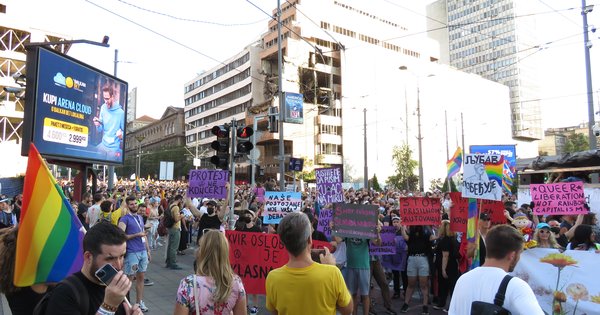
Thousands of people filled Nemanjina street in central Belgrade on Saturday afternoon, marching behind a drumming band and music trucks in the Pride Protest March that closes Belgrade Pride Week every year. Entry checkpoints at Manjež Park opened at 4 p.m.; the march itself stepped off an hour later, followed Nemanjina and Kneza Miloša streets past the government building, continued along Kralja Milana to Nikola Pašić Square and the National Assembly, and returned to the park for a closing concert.
It is worth sitting with how ordinary that description sounds, because for a long stretch of Belgrade Pride’s history, it wasn’t. As Balkan Insight and other outlets marking the occasion noted this week, Saturday’s march came 25 years after what’s remembered locally as “Bloody Pride” — the first Belgrade Pride, on June 30, 2001, when far-right activists and football hooligans beat participants in the street as police stood by. The next march, in 2010, sparked riots that injured about 140 people, most of them police officers. For years afterward, Belgrade either banned Pride outright or staged it under a security lockdown so heavy the event felt more like a state operation than a public celebration. It wasn’t reestablished on stable footing until 2014.
The demands haven’t moved. Neither has the government.
What has changed least in 25 years is the substance of what marchers are asking for. Serbia still has no Law on Same-Sex Partnerships and no Law on Gender Identity — meaning same-sex couples have no next-of-kin rights, no shared property protections, and no automatic say in a partner’s medical care. Transgender people can change the gender marker on their documents only through a medical route: since 2019 no surgery is required, but they need sign-off from a psychiatrist and an endocrinologist after a year of hormone therapy. Organizers have called on the government to pass both for years; both remain, in the words of Belgrade Pride’s own materials, “drafted and shelved.”
This year’s march also carried an explicit demand for a formal state apology to everyone prosecuted for their sexual orientation or gender identity before Serbia decriminalized same-sex relations in 1994, alongside calls for faster hate-crime prosecutions. Serbia is an EU candidate country, and Brussels tracks LGBTI treatment as part of its accession monitoring — a fact Pride organizers invoke deliberately, since every year the partnership law doesn’t move becomes another data point in that file.
A march inside a bigger political moment
Saturday’s Pride landed in the middle of Serbia’s broader political turbulence. A student-led movement that began after a fatal railway station canopy collapse in Novi Sad in late 2024 has grown into the most sustained challenge to President Aleksandar Vučić’s government in years, marked by mass protests and, at points, mass detentions. Marchers carried the slogan “Ima mesta za sve nas” (“There is room for all of us”), the same one used at the first Belgrade Pride in 2001, and Belgrade Pride organizers have leaned into the wider political moment rather than away from it, framing LGBTI+ rights and the demand for a government that answers to its citizens as facets of the same fight.
Pride Week itself ran August 31 through September 6, organized by Belgrade Pride alongside the Youth Initiative for Human Rights and other local groups, with exhibitions, film screenings, panel discussions, and sports events filling the days before Saturday’s march. That programming — built to be accessible well beyond the LGBTI+ community specifically — has helped Pride Week grow from a single contested march into something closer to a genuine cultural festival, even as the march itself keeps its “protest” framing on purpose.
What the day says, and doesn’t say
None of this means Belgrade has become an easy place to be visibly queer. Heavy policing remains a fact of the march rather than a formality, and organizers and attendees alike describe it as protection against a threat that hasn’t disappeared, not a ceremonial presence. Saturday still had friction: a verbal clash with a group gathered outside the Church of the Ascension on Kneza Miloša, some of them displaying a photograph of convicted war criminal Ratko Mladić, after which police detained a priest and removed three other people who had broken through the cordon around the National Assembly. But the fact that those were minor incidents, rather than a live question of whether the march could happen at all, says something real about the distance traveled since 2001.
Whether that distance shows up in Serbia’s law books is a different question, and it’s the one Belgrade Pride keeps marching to answer. For the LGBTI+ community across the wider Balkans — a region where Serbia, despite its unresolved legal gaps, has one of the region’s longer-running and most established Pride events — Saturday’s turnout is being read as a signal of where public appetite for change currently sits, even as the legislative machinery that would actually deliver it stays stalled.
Sources: Belgrade Pride — official site; Balkan Insight, “25 Years After Belgrade’s ‘Bloody Pride,’ Serbian LGBT Activists March On”; N1, live blog of the march; Radio Free Europe/Radio Liberty (Serbian); Belgrade Pride, “Transition in Serbia”; U.S. Embassy in Serbia security notice for September 5–6 events.